
The magna’Motr
Reimagining Magnetic Propulsion & Mechanical Transfer
The magna’Motr is an experimental motor concept engineered to harness magnetic interaction and directional mechanical force. By combining timed magnetic alignment with custom cam profiles, it explores high-efficiency motion transfer.
Engineering Note: Visual Concept vs. Physics Simulation
The 3D render above serves as a geometric and spatial proof-of-concept. While it illustrates the placement and intended motion of the internal components, it does not account for real-world dynamic forces such as magnetic flux decay, contact friction, or rotational inertia.
The next phase of development involves building a full rigid body dynamics (RBD) simulation—integrating magnetic force vectors and collision parameters—to validate mechanical continuity and refine the cam profiles before prototyping.
Core Mechanics
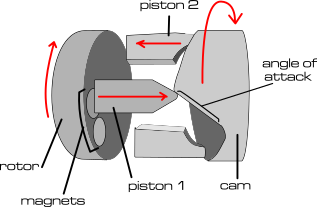
At the core of the design is a synchronized interaction between permanent magnets, reciprocating pistons, and a contoured cam mechanism. As magnetic attraction drives the linear movement of the pistons, the cam translates this force into smooth, continuous rotational energy.
Initial Attraction & Angle of Attack
Magnetic Engagement & Cam Path
How It Works
As the rotor turns, the internal magnets align with Piston 1, drawing it forward. The tip of the piston engages the specialized angle of attack on the stationary cam face, initiating mechanical conversion.
Mechanical Transfer
Reciprocating Transfer
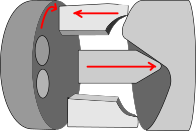
As Piston 1 reaches maximum displacement, the cam profile forces Piston 2 into position, resetting the cycle. This opposing dual-piston motion maintains continuous drive pressure across the rotor.
Cycle Completion
Continuous Rotation
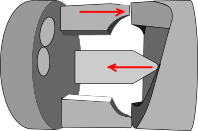
The momentum carries the rotor past the neutral magnetic zone, allowing the cycle to repeat seamlessly with minimal friction losses.